
In our article "◆ Things We Must Know About Buying a Harp◆," we already mentioned that the harp needs regular repair and maintenance. As CAMAC's original technicians are coming to Taiwan for repairs this month, the editor has specially prepared this article to provide more information and explanation on "Harp Repair and Calibration."
First, let us introduce the maintenance and repair services the Taiwan Harp Center provides. Our harp technicians are original technicians from France's CAMAC HARPS. CAMAC sponsors original technicians to provide repair services in various countries every year, and provides the most favorable repair prices to all customers who purchase CAMAC harps. Currently, the original technician in Taiwan in recent years is Nadav Konieczny, a harp technician from Israel. In addition to CAMAC harps, he also repairs harps of other brands.

Nadav
Nadav Konieczny


Q & A
Q: Why do harps need maintenance and regulation?
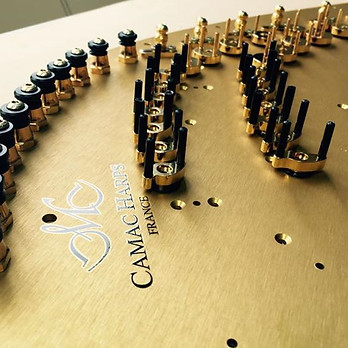
A: We all know that harps are made of wood, and visually, we can see that a significant part consists of intricate metal mechanisms. The process of making a harp is a highly specialized skill. Over years of playing, factors such as foot-pedaling, string vibrations, and movement can exert a pull of up to two tons on the strings, potentially causing slight displacements or even more serious issues with the mechanisms. Additionally, some parts of the harp are consumable components that wear out over time due to playing; if not replaced periodically, they can lead to further problems.
Instruments are primarily used to produce music, so tuning is a crucial aspect, closely tied to the precision of the harp's structure, especially the metal components. Therefore, even a minor discrepancy in the harp's metal mechanisms can affect the sound it produces. This underscores the importance of "harp maintenance and regulation."
Q: What are the basic maintenance tasks performed by professional technicians?
A: Unless specific urgent issues need immediate attention, technicians typically start their inspection from the base of the harp. After removing the base, they replace the pedal felt and then adjust and regulate the metal rods (Pedal Rod) connected to each pedal. Next, they calibrate the positions of the tuning pins and the tuning discs on the harp. While this may sound straightforward in a few sentences, adjusting over two thousand mechanical components is very time-consuming. Technicians use professional precision tuners to make these adjustments, so the maintenance work is quite complex!
Additionally, I'd like to point out that harp maintenance generally takes about 2.5 hours. However, CAMAC harps only require about 1.5 hours. The reason, as mentioned earlier, is that CAMAC incorporates many innovative improvements in their harps, even using different materials for some components. For instance, the pedal felt in other brands typically needs to be replaced every one to three years (depending on usage frequency), and the replacement process can be cumbersome and time-consuming. In contrast, CAMAC uses "Teflon" for their pedal felt, which can last up to ten years or longer before needing replacement, and the replacement process is quick and straightforward. Moreover, the disassembly and reassembly of the base is simplified for CAMAC harps, allowing technicians to adjust the length of the metal rods (Pedal Rod) without removing the base!
Q: Can CAMAC technicians also repair harps from other brands?
A: Essentially, the maintenance and repair processes for harps, regardless of brand, are quite similar. Technicians need to have a clear understanding of harp construction and possess a certain level of repair experience. However, the presence of "CAMAC technicians" is related to the unique manufacturing methods of CAMAC harps. In our feature on the "◆ Tour of the French CAMAC HARPS Factory ◆," we discussed many innovations and reforms in CAMAC's harp production. For instance, improvements to the base design allow technicians to calibrate the pedals and their connecting mechanisms without needing to disassemble the base. Therefore, to maintain and repair CAMAC harps, it is essential to understand their specific structure, and the best place to gain this knowledge and familiarity is at the CAMAC factory. This is why CAMAC has its own "factory technicians"!

Q: How often should harp maintenance be performed?
A: Almost every year, after we announce the technicians' visit to Taiwan, we receive numerous calls and emails asking whether their harps need maintenance.
Therefore, here’s a useful guideline to help you assess your own harp's condition.
This evaluation is based on the frequency of harp usage (playing):
This evaluation criterion is defined based on the frequency of harp usage (playing):
Once a year
Professional harpists, such as symphony harpists and event harpists, whether domestic or international.
Harps are frequently used for recording CDs.
Intermediate or music students who practice for more than two hours a day on average.
Once every two years
(Most applicable to the general public)
Students at an intermediate level or above.
Some harpists own two or more harps and use them alternately.
Harpists who occasionally perform for extra income.
Those who use their harp for 5 to 12 hours a week.
Once every three years
Beginner harpists.
Harp enthusiasts who practice about 5 hours a week or less.
Note: Lever harps generally do not require as much regular maintenance as pedal harps.
Therefore, the technician's recommendation is to wait until the second year after purchase for the first maintenance, and then to perform the second maintenance approximately every 6 to 8 years.
This is a simple assessment for everyone. Of course, if your harp has any issues, it is highly recommended to have a professional technician perform the repairs to ensure effective resolution!