
◆ CAMAC HARPS Factory Tour in France ◆
Before we begin our harp journey, let’s clarify that most of our articles are meant to share experiences, and this factory tour is no exception. The actual process of harp making is quite complex, involving numerous steps and procedures that require expertise in both wood and metal components. During this one-and-a-half-day tour, our editor and teachers listened attentively, asked questions, and took photos to document the experience. Now, we’re doing our best to translate what we heard, saw, and learned into words and images to share with our dear friends at the Taiwan Harp Center! We hope everyone finds some interesting information in this.
This time, the team from the Taiwan Harp Center, led by Director Chiu Meng-Lu, traveled to France to visit the CAMAC harp factory. This tour and learning experience truly opened our eyes. Not only did we gain a clearer understanding of the harp-making process, but we also learned more about the vision and dedication of the CAMAC harp-making team. Their commitment to the craft is genuinely admirable.
In early June 2016, the Taiwan Harp Center team arrived at Charles de Gaulle Airport in Paris. After resting for two days, we took a nearly four-hour drive. The scenery gradually shifted from skyscrapers to refreshing natural landscapes. Just when we were wondering about this remote location, we spotted the sign, and everyone suddenly felt enlightened and incredibly excited!

After following the directions and walking straight for a few minutes, we turned right, and a factory with clean white walls came into view (which was quite different from the factory image I had imagined, so I was a bit surprised). Once we parked, everyone eagerly searched for the entrance, and that’s how our tour began!

The tour of the factory took a full three hours to complete. It's not that the factory is so large that it requires that much time, but rather that the pace included stops for explanations and photo documentation. Throughout the entire visit, Executive Director Jakez personally introduced and explained everything to us, which we greatly appreciated. He didn't just give us a quick overview; he provided detailed explanations about different types of wood, their origins, the specifics of each work area, and the production and inspection of metal parts. This clearly shows that Jakez is a hands-on leader with a deep understanding of the factory's operations and processes.
(Photo/ The corridor connecting the office area and the harp-making area features a row of photos of renowned contemporary French harpists hanging on the left wall. All of them own and play CAMAC harps. These photos were specially taken by top French photographers invited by CAMAC. Additionally, there are several rooms on both sides of the corridor, including the harp finishing area, photography area, audition room, and more.)

First, Jakez informed us that aside from the office area at the front, the largest sections of the factory can be divided into two main areas: the "Woodworking Area" and the "Metal Installations and Parts Production Area."
Woodworking Area
Jakez led us to begin the tour in the "Woodworking Area." We first arrived at the innermost and quietest space of this section. The photos show that this is a storage room specially designed for various types of wood. It holds materials with different textures from different regions, and the humidity and temperature in the storage room are strictly controlled to ensure the quality of the wood.
Here, we find different types of wood, such as beech from Austria and maple from Canada. Each type of wood is allocated to different parts of the harp based on its properties, characteristics, stiffness-to-weight ratio, and other factors. For instance, the posts of the plucked harps are made entirely of beech, as it is heavy, hard, strong, and highly resistant to shocks. However, beech wood typically has a darker color. If a lighter-colored harp is desired, a layer of lighter wood veneer is applied, which is why the price of natural-colored harps tends to be higher than that of darker ones.

(圖/存放木材的儲藏室)

(圖/較深色的這區大多都是櫸木)

(圖/這是運用交錯結合技術的合成木,通常是用在豎琴最上面的琴頸,就是有撥鍵或是踏板琴機械面板的那一部分,可以從上面的繪圖看的出來。)
(圖/存放木材的儲藏室)
Here’s the translation for that part:
It's also worth mentioning the wood used to create the soul of the harp, the "spruce" soundboard (for related articles, please refer to The Soul of CAMAC Harps—The Soundboard). If you’ve seen our previous introduction about the soundboard, you’ll know that spruce is quite precious. Due to its source, wood properties, and delicacy, spruce requires different temperature and humidity controls compared to other woods. Therefore, the factory has a special storage room dedicated to preserving spruce wood (as shown in the photo below).

After the basic shapes are drawn, all the wood in the storage room is moved to the adjacent production area, where woodworkers begin processes such as cutting, polishing, assembling, and carving. Each of these procedures can be further divided into several steps, ranging from simple to complex. In the image below, the craftsman is performing the first operation, which involves making rough cuts along the grain of a batch of wood, followed by more precise cutting.


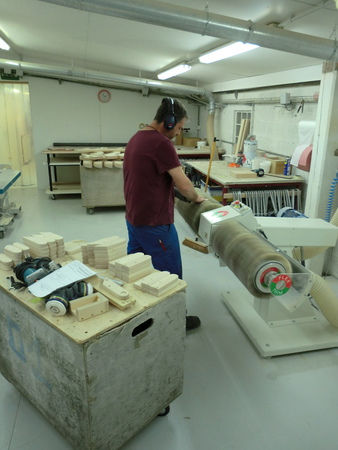
Next, all the cut wooden surfaces need to be smoothed out. Depending on the specific part of the harp, different sanding machines are used. For example, the machine in the first image is used for sanding small components, such as the harp legs, while the machine in the second image is for sanding the neck of the harp.
(圖一)

(圖二)
(圖一)
In the second image above, you can see that the neck of the harp has already been installed with the tuning pins. The perforation machine is the one shown in the image below. Depending on the different models and the sizes of the plucked and pedal harps, the perforation locations vary. Therefore, the workbench is covered with different data used to secure the neck. Next, a precise computer program is used to adjust the machine's operational data for the perforation process.

Next to it, there is a smaller machine specifically designed for the "DHC" electric harp's perforation. Since electric harps are equipped with electronic components, they are made with not only wood but also carbon fiber for the body structure, which requires a specialized perforation machine. The image below provides an overview of the perforation process.

(圖/師傅手上電鑽不是在幫豎琴穿孔唷!他正在拴緊用來固定琴身的固定器,為了不讓琴身在穿孔過程中移動而影響穿孔間距,因此拴緊的動作是非常重要的唷!)

(圖/琴身固定後,確認電腦數據後就可以開始進行,可以看到上方的穿孔機已從後方移動到琴身上方。)
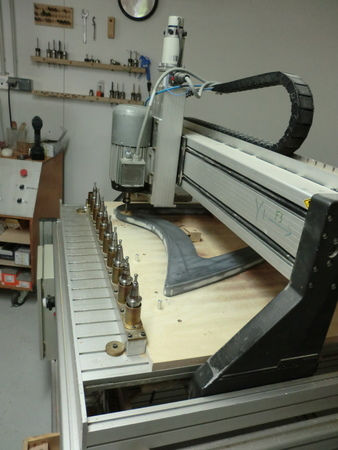
(圖/開始進行穿孔動作。)
(圖/師傅手上電鑽不是在幫豎琴穿孔唷!他正在拴緊用來固定琴身的固定器,為了不讓琴身在穿孔過程中移動而影響穿孔間距,因此拴緊的動作是非常重要的唷!)
Next, we arrived at the wooden assembly area, where there are many steps in the assembly process. The two main components being assembled here are the "soundbox" and the "base." What’s interesting about this space is that we can see a variety of wooden parts, which helps us understand how the complete harp we normally see is assembled from so many intricate details. It becomes clear just how complex this process really is.

(圖/師傅正在進行的是音箱內部的組裝。)

(圖:撥鍵琴的音箱內部)

(圖:師傅們將音箱與音箱邊木組合處上膠後,會運用大量的壓力夾將其黏著及固定。)
(圖/師傅正在進行的是音箱內部的組裝。)
Inside the assembly area, there is another section dedicated to the assembly and carving of the "harp columns." On the day of our visit, this area happened to be inactive, but we could see the wooden components used for making the columns, the machines in operation, and some semi-finished products.


(Photos/ Both images show the combination of harp column wood and carving machinery)

(圖/三張圖都是豎琴琴柱雕刻半成品)

(圖/三張圖都是豎琴琴柱雕刻半成品)

(圖/三張圖都是豎琴琴柱雕刻半成品)
(圖/三張圖都是豎琴琴柱雕刻半成品)
And this photo shows the completed harp bodies in the assembly area, lined up and waiting to enter the next stage of harp production.
However... huh? Why do we only see pedal harps?

In the previous area, the vast majority of the work involved the assembly of pedal harp wood. While we did see some assembly of the interiors of plucked harp bodies, there is a separate area dedicated specifically to the assembly of plucked harps. The assembly process for plucked harps is somewhat simpler and involves fewer steps compared to pedal harps, so everything is concentrated in one place for assembly. Therefore, in this area, you will only see the wooden components and accessories for plucked harps (as shown in the three images below).

(圖/撥鍵琴木材組裝區)

(圖/撥鍵琴木材組裝區)

(圖/相同於剛剛組裝區的壓力夾,這裡撥鍵琴的音箱內的邊調組裝也需要用大量壓力夾來黏合及固定。)
(圖/撥鍵琴木材組裝區)
After all the wooden components pass through the assembly area, there is a brief pause in the process. Although the harp is not yet fully formed, this is because there is one very, very important step that must be completed before adding the metal parts!
This step is divided into four actions: "Coloring and Lacquering," "Drying," "Polishing," and "Clean Room."
"Coloring" and "Drying" are straightforward and easy to understand. The "Lacquering" is a special protective coating for the wood, safeguarding it from moisture and oxidation. "Polishing" ensures that the finish and protective lacquer are even and smooth.
According to the CEO, the first three actions take the longest and require the most patience in harp production. Besides the drying phase, these three steps are repeated about six times or more because wood has many pores, and a single application cannot fill them all. Thus, these actions are repeated until the wood pores are completely filled!
The fourth action, the "Clean Room," serves as the final line of defense for wood protection. After undergoing the repetitive first three steps and ensuring that the wood pores are filled and the surface has a uniform, glossy finish, the wood is sent to the "Clean Room" for the final protective lacquer application. Since this is the last application, any potential dust in the air must be prevented from contaminating the harp and the lacquer, which is why a clean room is essential for this final wood protection process.

(圖/師傅正在為豎琴準備上色中,其實師傅背後牆上有很多色瓶,可惜沒有拍到入鏡。)

(圖/第一動作中的上漆,不用上色的原木會直接進來這裡上保護漆)

(圖:師傅正在進行的是第三動作的磨光。)
(圖/師傅正在為豎琴準備上色中,其實師傅背後牆上有很多色瓶,可惜沒有拍到入鏡。)
Metal Installations and Parts Production Area
Transitioning from the woodworking area to the metal installations and parts production area, not only are the work contents and environments vastly different, but even the scents in the air change—woodsy aromas give way to metallic ones! The Executive Director explained that to ensure the quality of every detail in each CAMAC harp, the factory has dedicated over a decade to bringing all component production back in-house. This is particularly important for these metal installations and parts, as they significantly impact the harp's operational quality. Every detail must be handled with care and precision.
Upon entering this production area, in addition to the large production machines that catch the eye, there are rows of laboratory-like rooms on the left. After the machines produce the parts, they must go through a series of manual processes and microscopic inspections to rigorously ensure the quality and stability of all components before they are sent to the assembly area for integration.

(Photo/ The "Metal Device and Parts Production Area" where machines are lined up. Not in the picture on the left is a row of rooms that look like laboratories. Due to the high demand for parts, the machines are almost always in operation. For example, the machine in front of you is in operation 24 hours a day, almost all year round. However, there are staff members who regularly check the machine settings, and then they will go through the inspection room to strictly check every tiny metal part under a microscope.)
Additionally, there’s something worth sharing with friends in Taiwan that makes us proud: this year, CAMAC acquired a large machine right in the "Metal Installations and Parts Production Area." On the day of our visit, we checked the machine's label and discovered that it was MADE IN TAIWAN! Jakez also mentioned that this machine is the top-tier equipment for producing these components (see photos one and two below).
Initially, to create parts suitable for CAMAC harps, CAMAC engineers collaborated to build a specialized machine (see photo three below). They used this machine for a long time, but recently, as the factory expanded and upgraded, they took the opportunity to seek out better production equipment to enhance the quality of harp components. Their search led them to this machine made in Taiwan! Jakez kindly expressed his gratitude for Taiwan's technology, which allows them to have the best equipment for crafting high-quality harps.

(圖一/這台就是我們台灣製作的金屬生產機器唷!)

(圖二/在機器上面還有中文標誌呢!真的很有意思~)

(圖三/可以看到左上角的標籤是"CAMAC",因為是由當年一群優秀的CAMAC工程師聯手打造出這台機器,經過多年的貢獻,已經功成身退的退休囉!)
(圖一/這台就是我們台灣製作的金屬生產機器唷!)
Once the components are assembled to a certain stage, this beautiful French woman conducts inspections and calibrations here. We can also see that the metal panel on the table is nearly complete, and it's about to be prepared for the harp assembly. This step is a crucial part of the process (though, to be honest, from the beginning of the tour until now, I feel that every step is very important! XD)

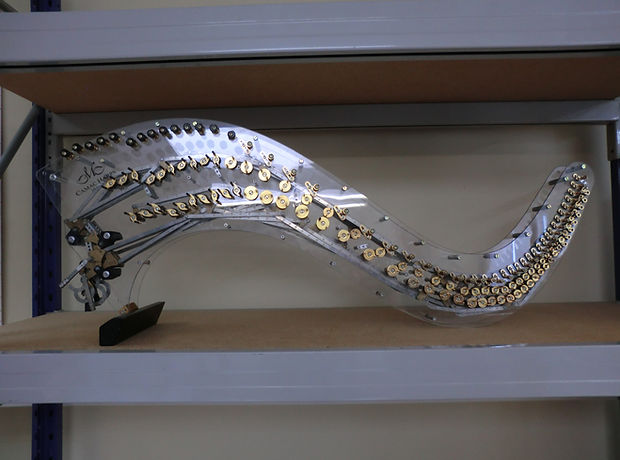
In addition, the photo below provides a perspective view that allows us to see the internal workings of the upper mechanism of the pedal harp, which is usually invisible. This part primarily controls the movement of the components when we step on the pedals, resulting in the raising and lowering of pitch. The mechanical principles involved represent a significant breakthrough in the history of harp development.
In the 17th and 18th centuries, there were only single-action pedal harps, which had just two grooves in the pedal area that could only raise the pitch by a semitone. Naturally, this limited the range of keys that could be played. It wasn't until the early 19th century that Sebastien Erard invented a key linkage mechanism and placed it in front of the long linear component controlling each string. This innovation led to the creation of the modern double-action pedal harp, which includes an additional groove, allowing each note to be played with three semitones.
This aspect makes us greatly admire the wisdom of our predecessors. Although Erard harps are no longer in production, the brilliance of Erard lives on in every modern harp. Thanks to Erard's innovations, the possibilities for harp performance have expanded, leading to a richer variety of harp music creations today.
This editor's somewhat unprofessional factory tour is coming to a close. After exploring the two main areas—woodworking and metal installations and parts production—the next step involves assembling and securing the entire harp. Following this, the harp undergoes repeated testing, calibration, and inspection to ensure its integrity and stability before it can be packed and shipped.
Having completed this tour, I feel a deep admiration and gratitude for everyone involved in harp production. This is a work that requires immense patience and attention to detail, where every step is interconnected and indispensable. It takes genuine dedication to create such a beautiful and intricate instrument.

